 |
||||
|
Protect the Children! Bare your Breasts!
BURN THIS PAGE . . . By P. Rapoport Hamilton [Ontario, Canada] Spectator, November 28, 2005. This article relates topfreedom, nudity, and sexuality to increase understanding in a few areas.
Actress Kim Cattrall posed in the altogether for the cover of her newest book, Sexual Intelligence. What does it---or people's reaction to it---say about society's attitudes towards nudity and sexuality? A few weeks ago, on a "Go" section cover, The Spectator printed a large photo of actor Kim Cattrall in connection with a new book of hers. Some readers complained about the photo because Cattrall was naked. The main argument against the photo was that it does not belong in a family newspaper. "Family" means a few things, chiefly the presence of children, also a certain parental attitude: young minds should not be polluted by nudity in a newspaper that arrives for breakfast. Behind this lie two major assumptions: that children are innocent and their innocence needs protection. Although in some ways children are innocent, many parents narrow that to mean ignorant and try to keep them so, especially in sexual matters. "Protection" via ignorance then easily backfires as a method of upbringing. It also loads burdens onto minors of all ages that adults fail socially to deal with.
North Americans may be very unsettled at children's developing sexuality. "Our culture deals with this inevitability," writes the social critic James Kincaid, "by issuing orders to deny it." Ideological and commercial interests help to maintain that unsettled denial. Ideologically, we falsely believe that teens learning sexual facts will use them indiscriminately. Commercially, advertising blasts us with sexual messages that we try to prevent many of their intended targets from heeding. Many deny reality constantly to maintain the myth that we can enforce minors' distancing from sex. The United States, for example, officially promotes and exorbitantly funds "abstinence-only" sex education. Five of the best American professional organizations have shown scientifically that it doesn't work, that vows of abstinence break far more easily than a good condom. The result: the U.S. government says that's not science. That kind of reaction reached its nadir a few years ago. In 1998, a scientific analysis by Rind, Tromovitch, and Bauserman claimed that not all sexual experiences of minors presumed harmful are actually so. What did the U.S. Congress do? It didn't say, "We'd better study this" or "We think your stats are wrong." As soon as it could, in a fit of political hysteria, it denounced the analysis in unanimous votes in both House and Senate. It lynched the messenger because it didn't want to understand the message. Promoting baseless fear reaps far more political benefits. Don't sneer at our southern neighbours, however. Canada, while better, is hardly free from criticism. Its government has tried hard to make some thoughts about sex a crime. Its pornography laws are based on discredited theories. Its police often wrongly claim that child sexual abuse is an epidemic. Ontario's Children's Aid societies threaten nudist families, who refuse to buy into body shame and phobia. And its sex-ed curriculum for elementary schools is warped by omission of important concepts.
That unhappy tale reminds me of an old joke about a four-year-old boy who spotted a totally naked woman standing up in a convertible. "Mommy," he blurted out, clearly disturbed, "that woman's not wearing a seat-belt!" The crusade for children's innocence takes other forms. Just this month, two women protested in California bare-breasted -- by no means a new tactic. Sacramento police arrested them for indecency and disorder, claiming their act "could corrupt children ... and cause sex offenders to run amok." There is no evidence whatever to support such claims. Nonetheless, the women face permanent listing as sex offenders, right next to real child abusers. That sort of thing happens in Canada, too. In the past 10 years, arrests of bare-breasted women in several provinces have been major news. In 2001, when the magnificent Breast of Canada calendar from Guelph showed women's complete breasts, it was labelled "pornographic." Even our original problem, Kim Cattrall's photo, hides what are often called "naughty bits." What message does that send to children?
Cattrall's new book is called Sexual Intelligence. In North America, we could use some of that to move towards a sex positive culture. Currently we convey mostly body negativity, in sexual politics of fear and hypocrisy. As protective measures for children, nothing could be worse.
|
||||
|
|
||||
|
|
||||
 |
|
 |
||

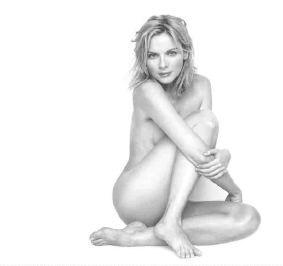 . . . there's "innocence" at risk. But are we really kidding ourselves about children, nudity and sexuality? Are we sending them a harmful message in the process?
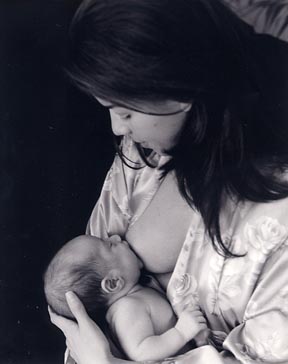 Bodies are one of those failures, in their unclothed state and sexual potential. We act in imaginative ways to keep even the topics of nudity and sexuality from minors. It doesn't matter that young children in all cultures prefer to be naked, that at very early ages they masturbate, if non-erotically, and that in adolescence they know well what erotic experience is.
 Obsession with sexuality may become absurd. Often, it results in those most afraid of it inducing plenty of harm where none existed. In Florida in 2004, a 22-year-old female babysitter undressed in front of her four-year-old male charge because he asked her to persistently, in his innocent way. The boy was declared psychologically damaged and sent to counselling. The babysitter faced 30 years in prison, much more than for murder.
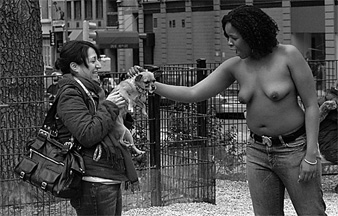 So we, too, can pin major harm on a tiny part of women's bodies. This nipplemania is the ultimate fetish. It blames women's nipples for disorder subsequently caused by police and calls them indecent to support false claims of protecting misconstrued innocence. We do not help children by teaching them intolerance, disgust, and unjust discrimination towards women's bodies or by hiding from them as much information as possible about bodies and sexuality.
| |||||
